

Choosing a name for your son is one of the most meaningful decisions you will ever make as a parent. Vintage baby boy names carry a sense of dignity, history, and timeless charm that modern names often struggle to replicate. These old-fashioned baby boy names have survived centuries, crossed cultural boundaries, and continue to enchant new generations of parents who want something rooted in tradition yet refreshingly distinctive.
TABLE OF CONTENTS ▼
- Why Vintage Baby Boy Names Are Trending Again
- How to Choose the Perfect Old-Fashioned Baby Boy Name
- Classic Victorian and Edwardian Baby Boy Names (1880s to 1910s)
- Roaring Twenties and 1930s Retro Baby Boy Names
- Mid-Century Vintage Baby Boy Names from the 1940s to 1960s
- Old-Fashioned Baby Boy Names with Southern Charm
- Rugged and Strong Vintage Baby Boy Names
- Short and Sweet Vintage Baby Boy Names
- Rare and Uncommon Vintage Baby Boy Names That Deserve a Comeback
- Vintage Baby Boy Names Inspired by Famous Historical Figures
- Vintage Baby Boy Names by Origin and Heritage
- Complete Master List of Vintage Baby Boy Names with Meanings
- Frequently Asked Questions About Vintage Baby Boy Names
- Choosing a Vintage Baby Boy Name Your Son Will Love Forever
Whether you are drawn to the elegance of the Victorian era, the rugged appeal of frontier-era classics, or the refined charm of Edwardian gentlemen, this comprehensive guide offers more than 500 vintage names for boys complete with their meanings and origins. While many parents today explore vintage baby girl names alongside their search for boys, this article is your definitive resource for finding that perfect classic boy name that will stand the test of time. From strong single-syllable options to grand multi-syllabic showstoppers, every name here has been carefully selected for its historical resonance and enduring appeal.
The beauty of vintage names lies in their ability to feel both familiar and surprising. Names like Theodore, Arthur, and Felix are experiencing a remarkable resurgence, while hidden gems like Ambrose, Percival, and Alaric remain largely undiscovered. If you are looking for a name that honors your family heritage, evokes a sense of strength and character, or simply sounds beautiful when called across a playground, you are in the right place. Let us explore the rich world of retro baby boy names together.
Why Vintage Baby Boy Names Are Trending Again
The resurgence of old-fashioned baby boy names is not a passing fad but rather a cultural shift that reflects how parents think about identity, legacy, and individuality. In an era dominated by invented spellings and hyper-modern constructions, many families are finding that the most distinctive choice is actually a name with deep historical roots. Classic baby boy names offer something that brand-new creations cannot: a proven track record of strength, elegance, and recognizability across generations.
Social media and popular culture have played a significant role in this revival. Television period dramas, classic literature adaptations, and celebrity name choices have reintroduced names like Atticus, Jasper, and Silas to mainstream consciousness. Parents who appreciate literary baby names and book-inspired names are particularly drawn to vintage options that carry the weight of great storytelling. Similarly, the rise of trendy baby names and modern baby names has paradoxically made old-fashioned choices feel more fresh and unexpected by comparison.
Another driving force behind this trend is the desire to honor family heritage. Many parents are looking to their grandparents and great-grandparents for inspiration, reviving names that might have skipped a generation or two. These traditional baby boy names serve as a bridge between past and present, connecting a child to their ancestry while giving them a name that feels perfectly suited to the modern world. The nostalgia factor is powerful, but it is the inherent quality of these names that truly makes them endure.
According to data from the Social Security Administration’s baby name database, many names that peaked in popularity between 1880 and 1950 are climbing the charts once again. This cyclical pattern suggests that the best vintage names never truly go out of style; they simply wait patiently for a new generation to rediscover their magic.
How to Choose the Perfect Old-Fashioned Baby Boy Name
Selecting from hundreds of vintage baby boy names can feel overwhelming, but approaching the decision with a clear framework makes the process both enjoyable and productive. The perfect name sits at the intersection of personal meaning, pleasant sound, and practical functionality. Before diving into the lists below, consider these essential factors that will help you narrow your choices and find a name that feels absolutely right for your family.
Start by considering the meaning and origin of each name. Vintage names often carry powerful meanings rooted in ancient languages like Latin, Greek, Hebrew, Old English, and Germanic tongues. A name meaning “brave protector” or “noble ruler” adds an invisible layer of significance that your son may come to cherish as he grows older. Many parents searching for virtue baby names find that vintage options naturally embody qualities like courage, wisdom, and integrity.
Think about how the name sounds with your surname. Say the full name out loud multiple times, testing it in everyday scenarios: calling it across a room, imagining it on a diploma, and whispering it to a newborn. Pay attention to the rhythm and flow. Generally, pairing a longer vintage first name with a shorter surname (or vice versa) creates a pleasing cadence. Also consider potential nicknames, as many vintage names come with built-in short forms that offer versatility.
Finally, check the current popularity of your favorite names. Some vintage names like Henry and Oliver have become so popular again that they may not feel as distinctive as you hoped. If uniqueness is important to you, look for names that are still in the “undiscovered” phase of their revival cycle. The lists below include both well-loved classics and rare baby names and unique baby names that remain refreshingly uncommon.
Pairing Vintage First Names with Modern Middle Names
One of the most effective naming strategies is to balance a vintage first name with a contemporary or complementary middle name. This approach gives your child the best of both worlds: the distinguished character of an old-fashioned name and the flexibility of a modern alternative. For example, pairing “Theodore” with a sleek middle name like “James” or “Cole” creates an appealing contrast that feels both classic and current.
Consider experimenting with different styles. Some parents enjoy pairing their vintage choice with nature baby names or earthy baby names as middle names, creating combinations like “Arthur River” or “Edmund Sage.” Others prefer celestial baby names or space baby names for a more ethereal quality, such as “Felix Orion” or “Hugo Stellan.” The middle name slot is also an excellent place for last names as first names, a trend that blends beautifully with vintage sensibilities.
If you are drawn to one-syllable boy names for their punchy simplicity, they work exceptionally well as middle names to complement a longer vintage first name. Think “Cornelius Grant,” “Archibald Blake,” or “Montgomery Chase.” Conversely, if you choose a short vintage first name like “Hugh” or “Rex,” a longer middle name adds weight and sophistication.
Do not forget to consider initials and monograms. In the vintage tradition, monogrammed items hold special significance, so ensure the initials do not spell anything unintended. Write out the full name, including middle name and surname, to check for awkward combinations before making your final decision.
Classic Victorian and Edwardian Baby Boy Names (1880s to 1910s)
The Victorian and Edwardian eras produced some of the most distinguished and elegant baby boy names in history. These names reflect a period of formality, literary achievement, and imperial grandeur, yet they possess a warmth and character that translates beautifully into modern life. Many of the names from this era have a stately quality that makes them perfect for parents seeking something refined and substantial.
Victorian parents favored names with strong consonant sounds and classical origins, drawing heavily from Biblical traditions, Greek mythology, and Latin roots. The influence of the British monarchy, the works of Charles Dickens and other literary giants, and the expansion of the British Empire all left their mark on naming conventions. Names like Albert, Frederick, and Ernest dominated birth registries, while more adventurous parents chose options like Percival, Montague, and Alistair.
What makes these names particularly appealing today is their built-in gravitas combined with approachable nicknames. Frederick becomes “Freddie,” Theodore becomes “Teddy,” and Reginald becomes “Reggie.” This duality allows a child to carry a formal, impressive name while enjoying a casual, friendly short form in everyday life. Parents who appreciate royal girl names and elegant baby names will find that the same regal qualities exist abundantly in Victorian boy names.
The following list represents the finest names from this remarkable era, each one carrying the weight of history while remaining perfectly wearable in the present day.
Popular Victorian Baby Boy Names with Meanings
These are the cornerstone names of the Victorian era, names that appeared frequently in birth records, literature, and royal courts throughout the late nineteenth century. They represent the mainstream naming taste of a period that valued tradition, morality, and classical education. Each name here has a proven pedigree and a meaning worthy of careful consideration.
Many of these classic boy names have direct connections to kings, saints, and legendary figures, giving them an automatic sense of authority and heritage. They work beautifully across cultures and pair well with virtually any surname. If you want a name that communicates strength, intelligence, and timeless style, this category is your starting point.
Parents who also explore classic girl names for siblings will find that Victorian boy names complement Victorian girl names perfectly, creating a cohesive naming theme within a family. The era’s commitment to meaningful names means every option here carries genuine depth.
Here are the most beloved Victorian baby boy names and their meanings:
- Albert – Noble and bright (Germanic)
- Alfred – Wise counselor (Old English)
- Archibald – Genuine, bold, and brave (Germanic)
- Arthur – Bear king (Celtic)
- Augustus – Great, magnificent (Latin)
- Bernard – Brave as a bear (Germanic)
- Cecil – Blind to one’s own beauty (Latin)
- Charles – Free man (Germanic)
- Clarence – Bright, clear (Latin)
- Clifford – Ford by a cliff (Old English)
- Cornelius – Horn, strong willed (Latin)
- Douglas – Dark river (Scottish Gaelic)
- Edgar – Wealthy spearman (Old English)
- Edmund – Prosperous protector (Old English)
- Edward – Wealthy guardian (Old English)
- Edwin – Wealthy friend (Old English)
- Ernest – Serious, resolute (Germanic)
- Eugene – Well-born, noble (Greek)
- Felix – Happy, fortunate (Latin)
- Ferdinand – Bold voyager (Germanic)
- Francis – Free man, Frenchman (Latin)
- Frederick – Peaceful ruler (Germanic)
- Geoffrey – Peaceful territory (Germanic)
- George – Farmer, earth worker (Greek)
- Gilbert – Bright pledge (Germanic)
- Harold – Army ruler (Old English)
- Harvey – Battle worthy (Breton)
- Henry – Ruler of the home (Germanic)
- Herbert – Bright army (Germanic)
- Horace – Timekeeper (Latin)
- Hugo – Mind, intellect (Germanic)
- Humphrey – Peaceful warrior (Germanic)
- Jasper – Treasurer (Persian)
- Lawrence – From Laurentum, crowned with laurel (Latin)
- Leonard – Brave lion (Germanic)
- Leopold – Bold people (Germanic)
- Lionel – Young lion (Latin)
- Louis – Famous warrior (Germanic)
- Maurice – Dark-skinned, Moorish (Latin)
- Montgomery – Man power (Norman French)
- Mortimer – Still water (Old French)
- Nathaniel – Gift of God (Hebrew)
- Neville – New town (Norman French)
- Nigel – Champion, dark (Latin/Gaelic)
- Norman – Man from the North (Germanic)
- Oliver – Olive tree (Latin)
- Oscar – Divine spear (Old English/Irish)
- Oswald – Divine power (Old English)
- Otto – Wealth, prosperity (Germanic)
- Percy – One who pierces the valley (French)
- Percival – One who pierces the vale (Old French)
- Philip – Lover of horses (Greek)
- Reginald – Ruler’s advisor (Germanic)
- Roland – Famous throughout the land (Germanic)
- Rupert – Bright fame (Germanic)
- Sidney – Wide meadow (Old English)
- Stanley – Stony clearing (Old English)
- Theodore – Gift of God (Greek)
- Vincent – Conquering (Latin)
- Walter – Ruler of the army (Germanic)
- Wilfred – Desires peace (Old English)
- William – Resolute protector (Germanic)
- Winston – Joyful stone (Old English)
Rare Edwardian Baby Boy Names Worth Reviving
The Edwardian era (roughly 1901 to 1914) was a brief but culturally rich period that produced some exceptionally refined names. While many Edwardian names overlap with the Victorian era, there are distinct choices from this period that feel particularly sophisticated and are ripe for rediscovery. These rare vintage boy names have the advantage of being historically legitimate while remaining virtually unknown on modern playgrounds.
Edwardian naming taste leaned toward the elegant and the literary, influenced by the Aesthetic Movement and the flourishing of arts and culture. Parents of this era were slightly more adventurous than their Victorian predecessors, experimenting with names drawn from mythological baby names, Continental European traditions, and romantic literature. The result is a collection of names that feel both distinguished and delightfully unexpected.
These names are ideal for parents who want something genuinely uncommon without resorting to invented spellings or modern fabrications. Each name here has a real history and a genuine meaning, yet very few children today carry them. If you want your son to be the only one in his class with his name, this is where to look.
Discover these hidden treasures from the Edwardian age:
- Alistair – Defender of the people (Scottish/Greek)
- Ambrose – Immortal (Greek)
- Aubrey – Elf ruler (Germanic)
- Basil – Royal, kingly (Greek)
- Benedict – Blessed (Latin)
- Bertram – Bright raven (Germanic)
- Cedric – Bounty, spectacle (Celtic/Literary)
- Clement – Merciful, gentle (Latin)
- Crispin – Curly-haired (Latin)
- Cyril – Lordly (Greek)
- Dorian – Gift (Greek)
- Ebenezer – Stone of help (Hebrew)
- Emeric – Industrious ruler (Germanic)
- Erasmus – Beloved (Greek)
- Evander – Good man (Greek)
- Florian – Flowering (Latin)
- Godfrey – Peace of God (Germanic)
- Gideon – Mighty warrior (Hebrew)
- Horatio – Timekeeper (Latin)
- Ignatius – Fiery one (Latin)
- Isidore – Gift of Isis (Greek)
- Josiah – God supports (Hebrew)
- Lancelot – Servant (Old French)
- Leander – Lion man (Greek)
- Montague – Pointed hill (Norman French)
- Phineas – Oracle (Hebrew)
- Quentin – Fifth (Latin)
- Raphael – God has healed (Hebrew)
- Sebastian – Venerable, revered (Greek/Latin)
- Sylvester – Of the forest (Latin)
- Thaddeus – Courageous heart (Aramaic)
- Tobias – God is good (Hebrew)
- Valentine – Strong, healthy (Latin)
- Virgil – Staff bearer (Latin)
- Willoughby – Farm among willows (Old English)
Roaring Twenties and 1930s Retro Baby Boy Names
The 1920s and 1930s were decades of dramatic contrast: jazz-age glamour followed by the grit of the Great Depression. The baby boy names from this era reflect both sides of this coin, encompassing dapper, sophisticated choices alongside strong, no-nonsense names that speak to resilience and determination. These retro baby boy names have a distinctive character that sets them apart from both earlier Victorian choices and later mid-century options.
The Jazz Age brought a sense of playfulness and style to naming, influenced by Hollywood’s golden era, the rise of radio celebrities, and the broader cultural explosion of the Roaring Twenties. Names became slightly shorter, more accessible, and infused with a certain debonair charm. Meanwhile, the Depression era favored sturdy, dependable names that conveyed strength and perseverance through difficult times.
Many of these names have a wonderful versatility that makes them feel at home in both formal and casual settings. They pair exceptionally well with Southern baby names, creating combinations that evoke the warmth and graciousness of a bygone era. Whether you are looking for something suave and sophisticated or solid and unpretentious, this decade has remarkable options to offer.
These names capture the spirit of an unforgettable era in American and British history, and each one brings its own story to the naming table.
Dapper Names from the Jazz Age
The Jazz Age names exude confidence, style, and a touch of glamour that makes them irresistible to modern parents. These are names that conjure images of well-dressed gentlemen, lively dance halls, and the sophisticated wit of F. Scott Fitzgerald characters. They carry an inherent coolness that newer names often try to manufacture but rarely achieve authentically.
What distinguishes Jazz Age names from their Victorian predecessors is a certain lightness and accessibility. While still formal enough for any professional setting, they feel approachable and friendly in everyday use. Many of these names appeared in the classic films and novels of the period, giving them a literary and cultural resonance that adds depth to their appeal.
Parents who enjoy musical baby names will find a natural connection here, as many Jazz Age names are associated with the legendary musicians, composers, and performers who defined the era. The rhythm and melody of these names reflect the musical innovation that made the 1920s so culturally transformative.
Here are the most stylish baby boy names from the Roaring Twenties:
- Bennett – Blessed (Latin)
- Calvin – Bald, hairless (Latin)
- Carlton – Free man’s town (Old English)
- Chester – Fortress, walled town (Latin)
- Clark – Clerk, scholar (Old English)
- Clifton – Town by a cliff (Old English)
- Dashiell – Page boy (French)
- Dexter – Right-handed, skillful (Latin)
- Elmer – Noble and famous (Old English)
- Fletcher – Arrow maker (Old French)
- Franklin – Free landholder (Old English)
- Garland – From the triangle-shaped land (Old English)
- Graham – Gravelly homestead (Old English)
- Hampton – Home settlement (Old English)
- Irving – Green river (Scottish)
- Jerome – Sacred name (Greek)
- Langston – Long stone (Old English)
- Leland – Meadow land (Old English)
- Lester – Roman town (Old English)
- Luther – Army of the people (Germanic)
- Mack – Son of (Gaelic)
- Mercer – Merchant (Old French)
- Milton – Mill town (Old English)
- Monroe – Mouth of the river Roe (Scottish Gaelic)
- Nelson – Son of Neil (English)
- Orville – Golden city (French)
- Palmer – Pilgrim (Old English)
- Preston – Priest’s town (Old English)
- Quincy – Estate of the fifth son (Old French)
- Roscoe – Deer forest (Old Norse)
- Sheldon – Steep-sided valley (Old English)
- Sterling – Of the highest quality (Old English)
- Sullivan – Dark-eyed (Irish Gaelic)
- Vernon – Place of alders (Gaulish/French)
- Wallace – Foreigner, stranger (Old French)
- Warren – Park keeper (Old French/Germanic)
- Willis – Resolute protector (Germanic)
Strong Depression-Era Vintage Boy Names
The Depression-era names of the 1930s reflect a generation that valued durability, character, and straightforward strength. These names have a no-nonsense quality that makes them feel grounded and reliable, characteristics that never go out of style. Parents during this period chose names that would serve their sons well through hardship and triumph alike.
Many of these names have a distinctly American flavor, influenced by the frontier spirit and working-class values that defined the era. They are the names of builders, farmers, soldiers, and leaders who shaped the modern world through sheer determination. For parents seeking edgy boy names and strong boy names with genuine historical weight, these Depression-era choices deliver authenticity that cannot be manufactured.
These names also work wonderfully as middle names or as inspiration for parents who want something robust without being overly formal. Their straightforward pronunciation and strong consonant sounds make them easy to carry through life with confidence.
Here are the strongest vintage names from the 1930s:
- Alvin – Elf friend, noble friend (Old English)
- Burl – Cup bearer (Old English)
- Clyde – Warm, friendly (Scottish)
- Dale – Valley (Old English)
- Dwight – Devoted to God (Flemish)
- Earl – Nobleman, warrior (Old English)
- Floyd – Grey-haired (Welsh)
- Grover – Grove of trees (Old English)
- Harlan – Rocky land (Old English)
- Homer – Pledge, hostage (Greek)
- Ira – Watchful (Hebrew)
- Jasper – Treasurer, bringer of treasure (Persian)
- Lyle – The island (Old French)
- Marvin – Sea friend (Welsh)
- Myron – Myrrh, sweet oil (Greek)
- Norris – Northerner (Old French)
- Orson – Bear cub (Latin/French)
- Otis – Wealth (Germanic)
- Ralph – Wolf counsel (Old Norse)
- Rex – King (Latin)
- Rufus – Red-haired (Latin)
- Sherman – Shearer of cloth (Old English)
- Silas – Forest, woods (Latin)
- Theron – Hunter (Greek)
- Virgil – Staff bearer (Latin)
- Wilbur – Wild boar (Germanic)
- Woodrow – Row of houses by a wood (Old English)
Mid-Century Vintage Baby Boy Names from the 1940s to 1960s
The mid-century period from the 1940s through the 1960s represents a golden age of American and British naming. These decades produced names that feel simultaneously nostalgic and forward-looking, shaped by the optimism of the post-war boom, the birth of rock and roll, and the dawn of the space age. Mid-century vintage names have a clean, confident quality that makes them exceptionally versatile and appealing to contemporary parents.
Post-war parents embraced names that felt hopeful and strong, reflecting their dreams for a brighter future. The 1950s in particular produced names with a wholesome, all-American charm that has become deeply attractive in our current cultural moment. These are names that evoke front porches, neighborhood baseball games, and the warm family values of a simpler time, even as they remain perfectly professional for boardrooms and beyond.
The influence of Hollywood, early television, and the emerging youth culture of the 1960s added variety and personality to naming trends. Parents began to experiment with names that felt a bit more relaxed and individualistic, paving the way for the more creative naming practices of later decades. The best mid-century names balance this easygoing spirit with the solid foundation of tradition.
For parents who love the idea of a name that is undeniably vintage yet never stuffy, the mid-century era offers an abundance of perfect choices.
Post-War Classic Baby Boy Names with Meanings
The post-war era of the late 1940s and early 1950s saw a surge in births and an accompanying explosion of naming creativity within traditional frameworks. These names reflect the confidence and optimism of a generation that had survived tremendous hardship and was determined to build something better. They carry an inherent sense of purpose and reliability.
Many post-war names draw from a mix of traditions. Parents honored fallen relatives, embraced patriotic names, and looked to both their heritage and the broader culture for inspiration. The result is a diverse collection that includes everything from traditional Anglo-Saxon names to choices influenced by European immigration and the increasingly multicultural fabric of American society. Some parents during this era were also drawn to city baby names and place names for babies, naming sons after hometowns or cities where they had been stationed during the war.
These names have a clean, honest quality that makes them especially appealing today. They are short enough to be practical yet distinctive enough to stand out in a crowd. Many of them come with excellent built-in nicknames that add a layer of casual warmth to their formal strength.
Explore these timeless post-war baby boy names:
- Alan – Handsome, cheerful (Celtic)
- Barry – Fair-headed (Irish Gaelic)
- Boyd – Yellow-haired (Scottish Gaelic)
- Bruce – From the brushwood thicket (Norman French)
- Carl – Free man (Germanic)
- Clayton – Place with good clay (Old English)
- Curtis – Courteous, polite (Old French)
- Darrell – Dearly loved (Old English/French)
- Dean – Valley (Old English)
- Dennis – Follower of Dionysius (Greek)
- Donald – World ruler (Scottish Gaelic)
- Duane – Dark, swarthy (Irish Gaelic)
- Eugene – Well-born, noble (Greek)
- Gary – Spear (Germanic)
- Gerald – Ruler with the spear (Germanic)
- Glenn – Valley (Scottish Gaelic)
- Gordon – Great hill (Scottish Gaelic)
- Grant – Great, large (Norman French)
- Keith – Wood, forest (Scottish Gaelic)
- Kenneth – Handsome, born of fire (Scottish Gaelic)
- Lance – Land (Germanic)
- Larry – From Laurentum (Latin)
- Lloyd – Grey-haired (Welsh)
- Murray – Lord of the sea (Scottish Gaelic)
- Neal – Champion (Irish Gaelic)
- Noel – Christmas (French/Latin)
- Philip – Lover of horses (Greek)
- Raymond – Wise protector (Germanic)
- Roger – Famous spear (Germanic)
- Roland – Famous throughout the land (Germanic)
- Roy – King (Old French/Gaelic)
- Russell – Red-haired, fox-colored (Old French)
- Stuart – Steward (Old English)
- Trevor – Great settlement (Welsh)
- Victor – Conqueror (Latin)
- Wayne – Wagon maker (Old English)
- Wesley – Western meadow (Old English)
Retro 1950s and 1960s Baby Boy Names with Timeless Appeal
The 1950s and 1960s produced names that feel like the bridge between the old world and the new. These are names that carry the warmth of Eisenhower-era America and the creative energy of the Kennedy years, making them incredibly versatile for modern use. They are polished without being pretentious and casual without being careless, striking the perfect balance that many parents seek.
Television played an enormous role in shaping name preferences during these decades. Characters from popular shows became naming inspirations, and the growing influence of celebrity culture introduced parents to a wider range of options. At the same time, traditional naming remained strong, with many families continuing to pass down names through generations.
What makes 1950s and 1960s names particularly interesting today is that they have been out of mainstream use just long enough to feel fresh again. Unlike names from the 1980s and 1990s, which can still feel dated, mid-century names have acquired a patina of vintage charm that elevates them. They are perfect for parents who want something that sounds established and mature from day one.
These retro gems are ready for a new generation:
- Bradford – Broad ford (Old English)
- Brent – Hill, holy one (Old English)
- Byron – At the barns (Old English)
- Clifton – Town by a cliff (Old English)
- Colton – Coal town (Old English)
- Conrad – Brave counsel (Germanic)
- Craig – Rock, crag (Scottish Gaelic)
- Darren – Great one (Irish Gaelic)
- Donovan – Dark-haired chief (Irish Gaelic)
- Dwight – White, fair one (Flemish)
- Garrett – Brave with a spear (Germanic)
- Gregory – Watchful, alert (Greek)
- Howard – High guardian (Old English)
- Irving – Green river, sea friend (Scottish)
- Kirk – Church (Old Norse)
- Lamar – Of the sea (Old French/Germanic)
- Laurence – From Laurentum (Latin)
- Lowell – Young wolf (Old French)
- Malcolm – Devotee of Saint Columba (Scottish Gaelic)
- Marshall – Horse servant, steward (Old French)
- Maxwell – Great stream (Scottish)
- Mitchell – Who is like God (Hebrew)
- Morris – Dark-skinned (Latin)
- Randolph – Shield wolf (Old English)
- Roderick – Famous ruler (Germanic)
- Shelton – Town on a ledge (Old English)
- Spencer – Steward, dispenser (Old French)
- Terrence – Smooth, polished (Latin)
- Thornton – Town of thorns (Old English)
- Vaughn – Small (Welsh)
- Vernon – Place of alders (Gaulish)
- Ward – Guardian, watchman (Old English)
- Wendell – Traveler, wanderer (Germanic)
Old-Fashioned Baby Boy Names with Southern Charm
There is something undeniably magnetic about Southern-style vintage baby boy names. These names carry the warmth, hospitality, and genteel tradition of the American South, where naming conventions have long emphasized family honor, literary heritage, and a distinctive sense of place. Southern names often combine formality with friendliness, resulting in names that are both impressive on paper and approachable in person.
The Southern naming tradition has several distinctive features that set it apart. Double names like “John David” and “William Clay” are common and beloved. Last names used as first names is a deeply rooted practice in Southern culture, with surnames like Beauregard, Jameson, and Sutton regularly appearing as given names. Family names are passed down with tremendous pride, often spanning five or six generations.
Southern names also draw heavily from the region’s rich literary tradition. The works of William Faulkner, Flannery O’Connor, Harper Lee, and Tennessee Williams have contributed memorable character names that real families have adopted with enthusiasm. This intersection of literature and naming gives Southern vintage names an extra layer of cultural depth that resonates with parents who value storytelling and heritage.
Whether or not you have Southern roots, these names offer a special combination of charm, strength, and personality that works beautifully anywhere in the world.
Gentleman Names from the American South
Southern gentleman names are distinguished by their courtly elegance and their ability to command respect while remaining warm and inviting. These are names that sound equally natural at a formal dinner party and a backyard barbecue, reflecting the South’s unique blend of refinement and down-to-earth hospitality. Many of them have been popular in the South for generations while remaining relatively uncommon in other regions.
The tradition of using surnames as first names is particularly strong in this category, with many of these choices originating as family surnames that were honored by being given to firstborn sons. This practice has spread far beyond the South and is now one of the most popular naming trends nationwide. Names like Anderson, Beckett, and Emerson perfectly illustrate how last names as first names can create sophisticated and memorable choices.
Many Southern vintage names also connect to the natural landscape of the region, echoing the importance of land and place in Southern identity. While not strictly nature baby names or earthy baby names, many carry subtle connections to the fields, rivers, and forests that define the Southern landscape. This grounding in place gives them an organic, authentic quality.
These gentleman names bring Southern grace to any family:
- Anderson – Son of Andrew (Scandinavian/English)
- Atticus – From Attica (Latin)
- Beauregard – Beautiful gaze (French)
- Beckett – Bee cottage (Old English)
- Boone – Good (Old French)
- Braxton – Brock’s town (Old English)
- Caldwell – Cold well (Old English)
- Calloway – Pebbly place (Old English)
- Clayton – Town built on clay (Old English)
- Colby – Dark-haired settlement (Old Norse)
- Crawford – Ford of the crows (Old English)
- Easton – East-facing place (Old English)
- Ellington – Elli’s town (Old English)
- Emmett – Universal, truth (Germanic/Hebrew)
- Flannery – Red valor (Irish Gaelic)
- Forrest – Dweller near the woods (Old French)
- Hampton – Home settlement (Old English)
- Harrison – Son of Harry (English)
- Houston – Hugh’s town (Scottish)
- Jackson – Son of Jack (English)
- Jameson – Son of James (English)
- Jefferson – Son of Jeffrey (English)
- Langston – Long stone (Old English)
- Lawson – Son of Lawrence (English)
- Merritt – Worthy, deserving (Old English)
- Monroe – Mouth of the river Roe (Scottish Gaelic)
- Palmer – Pilgrim bearing palms (Old English)
- Prescott – Priest’s cottage (Old English)
- Rhett – Advice, counsel (Dutch)
- Sawyer – Woodcutter (Old English)
- Shelby – Willow farm (Old Norse)
- Sutton – Southern homestead (Old English)
- Tanner – Leather worker (Old English)
- Thatcher – Roof thatcher (Old English)
- Walker – Cloth walker, fuller (Old English)
- Whitfield – White field (Old English)
Rugged and Strong Vintage Baby Boy Names
Some vintage baby boy names carry an unmistakable sense of power, resilience, and rugged masculinity. These are names forged in the crucible of history, borne by warriors, explorers, and pioneers who shaped the world through courage and determination. For parents seeking a name that communicates strength without aggression and confidence without arrogance, these rugged vintage options deliver exactly the right tone.
The appeal of strong vintage boy names lies in their straightforward, no-frills character. They tend to feature hard consonant sounds, short syllables, and meanings drawn from battle, nature, and leadership. Unlike trendy modern names that may feel forceful or contrived, these names achieve their strength organically through centuries of genuine use by real men who lived remarkable lives.
Many of these names overlap with the frontier and pioneer traditions of America, Britain, and Europe, where physical endurance and moral courage were essential qualities. They also connect to the Norse, Germanic, and Celtic traditions that produced some of the most powerful names in Western history. Parents who are drawn to edgy boy names will find that authentic vintage options are far more compelling than artificially tough modern inventions.
These are names built to last, names that will serve your son well whether he becomes a CEO, a craftsman, an artist, or an adventurer.
Vintage Boy Names with Powerful Meanings
Every name in this collection was selected specifically for its powerful meaning and formidable sound. These are not merely old names; they are names that actively convey qualities like bravery, leadership, wisdom, and protection. Giving your son one of these names is like giving him an invisible suit of armor, a reminder of the strength that lives within his very identity.
The meanings behind these names span a fascinating range of powerful concepts. Some reference animals known for their strength, like bears, wolves, and lions. Others invoke natural forces, military prowess, or divine protection. A few carry the weight of mythological baby names, connecting to ancient heroes and gods whose stories have inspired humanity for millennia.
What sets these vintage options apart from modern “strong” names is their authenticity. Names like Everett, Garrison, and Barrett have been tested over generations and proven their worth. They do not need to try to sound tough because their history and meaning speak for themselves.
These names are particularly popular among parents who want their children’s names to carry aspirational qualities and serve as lifelong sources of inspiration:
- Alexander – Defender of the people (Greek)
- Angus – One strength (Scottish Gaelic)
- Barrett – Bear strength (Germanic)
- Barnaby – Son of consolation (Aramaic)
- Bjorn – Bear (Old Norse)
- Brock – Badger (Old English)
- Callahan – Bright-headed (Irish Gaelic)
- Conrad – Brave counsel (Germanic)
- Donovan – Dark warrior (Irish Gaelic)
- Duncan – Dark warrior (Scottish Gaelic)
- Emery – Industrious ruler (Germanic)
- Everett – Brave as a wild boar (Old English)
- Garrison – Spear-fortified town (Old French)
- Griffin – Strong lord (Welsh)
- Gunnar – Battle warrior (Old Norse)
- Harvey – Battle worthy (Breton/French)
- Hector – Holding fast (Greek)
- Kendrick – Royal power (Old English/Welsh)
- Magnus – Great (Latin)
- Maximus – Greatest (Latin)
- Murdoch – Sea warrior (Scottish Gaelic)
- Osborne – Divine bear (Old English)
- Ragnar – Warrior of judgment (Old Norse)
- Redmond – Wise protector (Old English)
- Roland – Famous land (Germanic)
- Sigmund – Victorious protector (Old Norse)
- Stellan – Calm, peaceful (Old Norse)
- Thor – Thunder (Old Norse)
- Titus – Title of honor (Latin)
- Ulric – Wolf ruler (Old English)
- Valerian – Strong, vigorous (Latin)
- Wolfgang – Traveling wolf (Germanic)
Short and Sweet Vintage Baby Boy Names
Short vintage baby boy names prove that you do not need multiple syllables to make a powerful impression. These one- and two-syllable classics pack enormous character into compact packages, offering names that are easy to spell, simple to pronounce, and impossible to forget. In an era of increasingly elaborate names, there is something refreshingly direct about a name that gets straight to the point.
Parents who appreciate one-syllable boy names will find an abundance of options in the vintage category. Names like Hugh, Grant, Clive, and Rex are complete statements in a single syllable, requiring no abbreviation or nickname because they are already perfectly streamlined. Similarly, four-letter baby names like Otis, Arlo, Hugo, and Ezra offer that sweet spot of brevity with just enough complexity to feel substantial.
Short names also have practical advantages. They pair beautifully with longer middle names and surnames, they look clean on documents and nameplates, and they are easy for young children to learn to write. Many parents who are choosing names for twins or large families appreciate the efficiency of shorter names, especially when coordinating sibling name sets. While searching for one-syllable girl names to pair with these, parents often find that short vintage names create wonderfully harmonious sibling sets.
Do not mistake brevity for lack of depth. Every short name here carries centuries of history and a meaning that transcends its compact form.
- Abe – Father of many (Hebrew)
- Ace – One, unity (Latin)
- Arlo – Fortified hill (Old English)
- Axel – Father of peace (Scandinavian)
- Beau – Handsome (French)
- Blake – Dark, fair (Old English)
- Blaine – Slender, thin (Scottish Gaelic)
- Cade – Round, gentle (Old English)
- Cass – Treasurer (Latin/Irish)
- Clay – Mortal, earth (Old English)
- Clive – Cliff (Old English)
- Cole – Charcoal, dark (Old English)
- Drew – Manly, courageous (Greek)
- Eli – Ascended, exalted (Hebrew)
- Ezra – Helper (Hebrew)
- Finn – Fair, white (Irish Gaelic)
- Flynn – Son of the red-haired one (Irish Gaelic)
- Gage – Pledge, oath (Old French)
- Grant – Great, large (Norman French)
- Gus – Great, magnificent (Latin)
- Hale – Hero, from the hall (Old English)
- Heath – Heathland dweller (Old English)
- Hugh – Mind, intellect (Germanic)
- Ike – Laughter (Hebrew)
- Ivan – God is gracious (Slavic)
- Jace – Healer (Greek)
- Joel – Jehovah is God (Hebrew)
- Jules – Youthful (Latin)
- Knox – Round hill (Old English)
- Kurt – Courteous, polite (Germanic)
- Lars – Crowned with laurel (Scandinavian)
- Lee – Meadow (Old English)
- Lev – Heart, lion (Hebrew/Russian)
- Liam – Resolute protector (Irish)
- Luke – Light-giving (Greek)
- Miles – Soldier (Latin)
- Milo – Soldier, merciful (Latin/Germanic)
- Ned – Wealthy guardian (Old English)
- Noel – Christmas (French)
- Otis – Wealth (Germanic)
- Owen – Young warrior (Welsh)
- Paul – Small, humble (Latin)
- Penn – Enclosure (Old English)
- Quinn – Wise, chief (Irish Gaelic)
- Reed – Red-haired (Old English)
- Rex – King (Latin)
- Rhys – Enthusiasm, ardor (Welsh)
- Ross – Headland, promontory (Scottish Gaelic)
- Seth – Appointed (Hebrew)
- Tate – Cheerful (Old English)
- Thane – Clan chief (Scottish)
- Troy – Foot soldier (Irish Gaelic)
- Wade – To go, ford (Old English)
- Wren – Small bird (Old English)
- Zane – God is gracious (Hebrew variant)
Rare and Uncommon Vintage Baby Boy Names That Deserve a Comeback
While popular vintage names like Henry, Theodore, and Oliver dominate the revival trend, there exists a vast treasure trove of rare vintage boy names that have been virtually forgotten by modern parents. These names were once commonplace in birth registries throughout the 1800s and early 1900s but gradually fell out of use as naming tastes shifted. Today, they represent an extraordinary opportunity for parents who want a genuinely unique name with authentic historical credentials.
The advantage of choosing a rare baby name from the vintage category rather than inventing something entirely new is that these names come pre-loaded with etymology, cultural context, and historical legitimacy. Your son’s name will not be a random assemblage of syllables but rather a real name with real roots, one that simply happens to be extremely uncommon in the current generation. This combination of uniqueness and authenticity is nearly impossible to achieve with modern name inventions.
Many of the rarest vintage names have fallen out of favor for no particular reason. They were not associated with negative events or figures; they simply drifted out of fashion as newer names took their place. This makes them ideal candidates for revival, as they carry no baggage and offer a blank canvas for your son to make entirely his own. While parents exploring vintage baby girl names have successfully revived names like Cordelia and Ophelia, the boys’ side has even more undiscovered territory to explore.
Prepare to discover names you may have never encountered before, each one a hidden gem waiting to shine again.
Hidden Treasures from the Past
These hidden treasure names represent the forgotten middle class of vintage naming: names that were neither extremely common nor extremely rare in their heyday, making them perfectly usable yet wonderfully distinctive today. They have been gently weathered by time, acquiring the kind of patina that makes them feel both ancient and fresh simultaneously.
Many of these names would feel right at home in a period novel or a historical film, yet they sound surprisingly natural when applied to a modern child. Their unfamiliarity is actually an asset, as it means your son will never have to share his name with three other classmates. At the same time, these names are easy to spell and pronounce, avoiding the common pitfall of unusual names that create lifelong confusion.
Some of these hidden treasures have connections to color baby names, referencing hair color or complexion in their original meanings. Others subtly reference the natural world, connecting to the enduring appeal of nature baby names and earthy baby names without being overtly botanical or geographical. These subtle connections add layers of meaning that enrich the naming experience.
Explore these remarkable names that time nearly forgot:
- Abelard – Noble strength (Germanic)
- Alaric – All-powerful ruler (Germanic)
- Aldous – Old, wise (Old English)
- Aloysius – Famous warrior (Germanic)
- Anselm – Divine helmet (Germanic)
- Balthazar – Baal protects the king (Babylonian)
- Barnabas – Son of consolation (Aramaic)
- Bartholomew – Son of furrows (Aramaic)
- Beaumont – Beautiful mountain (French)
- Benaiah – Built by God (Hebrew)
- Broderick – Brother (Old Norse/Welsh)
- Cabot – To sail (Old Norman French)
- Cassius – Empty, vain (Latin)
- Chauncey – Chancellor (Old French)
- Cosmo – Order, beauty (Greek)
- Cuthbert – Famous, brilliant (Old English)
- Dashwood – From the ash tree wood (Old English)
- Elsworth – Noble estate (Old English)
- Ephraim – Fruitful (Hebrew)
- Fergus – Man of vigor (Scottish Gaelic)
- Fitzwilliam – Son of William (Norman French)
- Gareth – Gentle (Welsh)
- Hartley – Stag meadow (Old English)
- Ignatius – Fiery one (Latin)
- Jedidiah – Beloved by God (Hebrew)
- Lazarus – God has helped (Hebrew)
- Lysander – Liberator (Greek)
- Matthias – Gift of God (Hebrew)
- Oberon – Noble bear (Germanic)
- Peregrine – Traveler, pilgrim (Latin)
- Phineas – Oracle, serpent’s mouth (Hebrew)
- Remington – Settlement on the riverbank (Old English)
- Solomon – Peaceful (Hebrew)
- Thaddeus – Courageous heart (Aramaic)
- Tobias – God is good (Hebrew)
- Ulysses – Wrathful (Latin/Greek)
- Whitaker – White field (Old English)
- Zebedee – Gift of God (Hebrew)
Rare Vintage Names You Have Probably Never Heard
For the truly adventurous parent, these are the most obscure and forgotten vintage boy names that even name enthusiasts may not recognize. These names have been buried so deep in historical records that they feel almost like new discoveries. Yet each one was a legitimate, documented name used by real families, and each one carries a genuine meaning worth celebrating.
Choosing one of these names is a bold statement. It says that you value originality, that you have done your research, and that you trust your son to carry a truly singular name with confidence. These are not names for the faint of heart, but for parents who understand that the most memorable names are often the ones nobody else thought to choose.
Some of these names have fascinating connections to historical professions, geographical features, or personal qualities that were highly valued in centuries past. They offer a window into how our ancestors thought about identity and aspiration, encoding their hopes and values into the very names they gave their children.
These are the ultimate deep cuts of the vintage naming world:
- Algernon – With a mustache (Norman French)
- Amos – Carried by God (Hebrew)
- Aristide – Son of the best (Greek)
- Augustin – Great, venerable (Latin)
- Barnett – Noble strength (Old English)
- Bramwell – Broom well (Old English)
- Caius – Rejoice (Latin)
- Carlisle – Castle of Lugus (Celtic/Old English)
- Cornelius – Horn, strong-willed (Latin)
- Dashiel – Heaven (French variant)
- Elias – Yahweh is my God (Hebrew/Greek)
- Eustace – Fruitful, stable (Greek)
- Fabian – Bean grower (Latin)
- Fitzroy – Son of the king (Norman French)
- Hadrian – From Hadria (Latin)
- Inigo – Fiery (Spanish/Basque)
- Josias – God supports (Hebrew)
- Kenelm – Brave helmet (Old English)
- Linus – Flax (Greek)
- Lucius – Light (Latin)
- Marchmont – Borderland hill (French)
- Nicodemus – Victory of the people (Greek)
- Octavius – Eighth (Latin)
- Osmond – Divine protector (Old English)
- Philemon – Loving (Greek)
- Prosper – Fortunate, successful (Latin)
- Ransom – Son of Rand (Old English)
- Septimus – Seventh (Latin)
- Sheridan – Seeker (Irish Gaelic)
- Theron – Hunter (Greek)
- Tiberius – Of the Tiber (Latin)
- Winslow – Friend’s hill (Old English)
- Zebulon – Exalted, honored (Hebrew)
Vintage Baby Boy Names Inspired by Famous Historical Figures
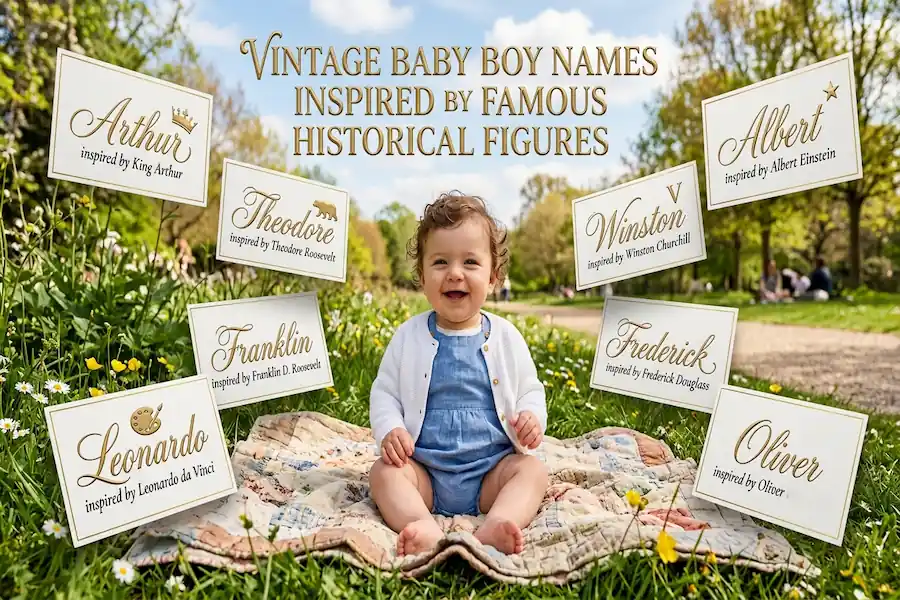
Few things add more weight and meaning to a name than a connection to a great historical figure. Throughout history, presidents, writers, scientists, philosophers, and explorers have carried names that now serve as tributes to their extraordinary achievements. Choosing a name inspired by a historical icon gives your son an instant role model and a name that carries cultural resonance far beyond its linguistic meaning.
This practice of naming children after admired figures is one of humanity’s oldest traditions. In ancient Rome, boys were named after generals and statesmen. In medieval Europe, saints’ names were chosen to invoke divine protection. In America, presidential names have been popular since the founding of the republic. The vintage baby boy names below represent a curated collection of the most inspiring figures from history, each one lending their name to a new generation.
What makes this approach particularly effective is that it provides a built-in story for your child’s name. When people ask “why did you choose that name,” you have a meaningful answer ready. Whether it is the courage of a wartime leader, the creativity of a great artist, or the wisdom of a philosopher, the association adds dimension to what might otherwise be just a pleasant sound.
These names span multiple centuries and cultures, offering something for every taste and every set of values.
Presidents, Writers, and Icons
From the corridors of power to the pages of great literature, these names have been carried by some of the most remarkable people in recorded history. Each name here was selected not just for its historical association but also for its inherent beauty and wearability as a modern baby name. A name does not need to be explained constantly to be a good choice, and every option here stands perfectly well on its own merits.
The literary names in this category are particularly appealing to parents who value the written word. Parents who are drawn to literary baby names and book-inspired names will find a wealth of options connected to beloved authors and unforgettable characters. From the Romantic poets to the American novelists, literature has produced some of the most beautiful names in the English language.
Presidential and political names carry an air of leadership and public service that many parents find attractive. These are names associated with courage, vision, and the ability to inspire others. They feel substantial and dignified without being stuffy, making them excellent choices for parents who envision their son as a future leader.
Here are vintage names immortalized by history’s greatest figures:
- Abraham – Father of many (Hebrew) — Abraham Lincoln
- Benjamin – Son of the right hand (Hebrew) — Benjamin Franklin
- Calvin – Bald (Latin) — Calvin Coolidge
- Chester – Fortress (Latin) — Chester A. Arthur
- Clarence – Bright (Latin) — Clarence Darrow
- Darwin – Dear friend (Old English) — Charles Darwin
- Edison – Son of Edward (Old English) — Thomas Edison
- Emerson – Son of Emery (Germanic) — Ralph Waldo Emerson
- Franklin – Free landholder (Old English) — Franklin D. Roosevelt
- Grover – Grove of trees (Old English) — Grover Cleveland
- Hamilton – Treeless hill (Old English) — Alexander Hamilton
- Harrison – Son of Harry (English) — Benjamin Harrison
- Hawthorne – Hawthorn tree (Old English) — Nathaniel Hawthorne
- Jefferson – Son of Jeffrey (English) — Thomas Jefferson
- Keats – Kite bird (Old English) — John Keats
- Lincoln – Town by the pool (Celtic/Old English) — Abraham Lincoln
- Marshall – Horse servant (Old French) — Thurgood Marshall
- Monroe – Mouth of the Roe (Scottish Gaelic) — James Monroe
- Nelson – Son of Neil (English) — Admiral Horatio Nelson
- Orwell – Branch of the river (Old English) — George Orwell
- Shelley – Clearing on a slope (Old English) — Percy Bysshe Shelley
- Sullivan – Dark-eyed (Irish) — Louis Sullivan
- Tennyson – Son of Dennis (English) — Alfred, Lord Tennyson
- Truman – Faithful man (Old English) — Harry S. Truman
- Whitman – White man (Old English) — Walt Whitman
- Wilson – Son of Will (English) — Woodrow Wilson
- Winston – Joyful stone (Old English) — Winston Churchill
Vintage Baby Boy Names by Origin and Heritage
One of the most rewarding ways to choose a vintage baby boy name is to explore options rooted in your family’s cultural heritage. Names carry the DNA of their linguistic and cultural origins, and selecting a name from your ancestral tradition creates a powerful connection between your son and the generations who came before him. Even if you are drawn to a culture that is not your own, understanding a name’s origin adds depth and intentionality to your choice.
The vintage names in this section are organized by their primary linguistic and cultural origins. You will find that many names appear across multiple traditions, reflecting the interconnected history of European and Near Eastern civilizations. English names borrowed from French, which borrowed from Latin, which borrowed from Greek, creating a rich tapestry of shared naming heritage.
Understanding origins also helps you appreciate the subtle differences between names that might seem similar on the surface. A Germanic name like Friedrich carries different cultural connotations than its English equivalent Frederick, even though both share the same root meaning. These nuances can help you make a more informed and personally meaningful choice.
Explore vintage names organized by their cultural heritage to find the perfect option that honors your family’s story.
English and British Vintage Baby Boy Names
English and British naming traditions form the backbone of the vintage baby name canon in the English-speaking world. These names draw from Anglo-Saxon, Norman French, and medieval English sources, creating a collection that spans more than a thousand years of British history. They have a distinctive character that is both sturdy and sophisticated, reflecting the island nation’s complex cultural heritage.
Many English vintage names have strong connections to place and landscape, reflecting the importance of land and locality in British identity. Names like Clifford, Ashton, and Heath evoke the English countryside, while names like Winston, Stanley, and Neville carry the gravitas of aristocratic and political tradition. This blend of pastoral simplicity and institutional authority gives English names their unique appeal.
The British royal family has exerted enormous influence on naming trends for centuries, and many of the most enduring vintage names owe their longevity to royal usage. From Edward and George to Albert and Arthur, royal names have a built-in prestige that transcends fashion and geography.
These classic English and British names are among the most reliable choices in the vintage naming world:
- Alistair – Defender of the people (Scottish variant of Alexander)
- Ashton – Ash tree town (Old English)
- Cedric – Kind, loved (Celtic/Literary)
- Chadwick – From the warrior’s town (Old English)
- Edmund – Prosperous protector (Old English)
- Edwin – Wealthy friend (Old English)
- Godfrey – Peace of God (Old English/Germanic)
- Hadley – Heather meadow (Old English)
- Kingsley – King’s meadow (Old English)
- Langley – Long meadow (Old English)
- Nigel – Champion (Latin/Old English)
- Oswald – Divine power (Old English)
- Pembroke – Headland (Welsh/Old English)
- Reginald – King’s advisor (Old English/Latin)
- Rupert – Bright fame (Germanic/English)
- Warwick – Settlement by the weir (Old English)
- Weston – Western town (Old English)
Irish and Scottish Vintage Baby Boy Names
Irish and Scottish names possess a lyrical, almost musical quality that sets them apart from their English counterparts. Rooted in the Gaelic language and Celtic cultural tradition, these names carry the spirit of ancient clans, legendary warriors, and the hauntingly beautiful landscapes of Ireland and Scotland. They are among the most romantic and evocative names in the Western naming tradition.
The Gaelic naming tradition places enormous importance on meaning and family connection. Many Irish and Scottish names reference natural phenomena, personal qualities, or clan allegiance, creating names that function almost like tiny poems. The sound system of Gaelic also produces distinctive phonetic combinations that give these names their characteristic charm.
These names have experienced a significant revival in recent years, driven by interest in Celtic heritage and the enduring appeal of Irish and Scottish culture worldwide. They pair beautifully with both traditional and modern surnames, and they work well in combination with names from other traditions.
Discover the beauty of Gaelic vintage naming:
- Angus – One strength (Scottish Gaelic)
- Brennan – Sorrow, descendant of Braonán (Irish Gaelic)
- Callum – Dove (Scottish Gaelic)
- Ciaran – Little dark one (Irish Gaelic)
- Cormac – Chariot driver (Irish Gaelic)
- Declan – Full of goodness (Irish Gaelic)
- Dermot – Free from envy (Irish Gaelic)
- Donegal – Fort of the foreigners (Irish Gaelic)
- Eamon – Wealthy protector (Irish Gaelic)
- Fergal – Man of valor (Irish Gaelic)
- Fergus – Man of vigor (Scottish Gaelic)
- Finbar – Fair-haired (Irish Gaelic)
- Hamish – Supplanter (Scottish Gaelic)
- Lachlan – From the land of lakes (Scottish Gaelic)
- Niall – Champion (Irish Gaelic)
- Oisin – Little deer (Irish Gaelic)
- Padraig – Noble (Irish Gaelic)
- Ronan – Little seal (Irish Gaelic)
- Seamus – Supplanter (Irish Gaelic)
- Torquil – Thor’s cauldron (Scottish Gaelic/Norse)
French Vintage Baby Boy Names
French vintage baby boy names bring an unmistakable elegance and sophistication that few other naming traditions can match. The French language lends itself naturally to beautiful names, with its soft consonants, nasal vowels, and melodic rhythms creating options that sound like poetry spoken aloud. These names carry the cultural weight of one of the world’s most influential civilizations.
French naming has been shaped by the Catholic tradition, the aristocratic system, and the country’s rich literary and artistic heritage. Many French vintage names have crossed the Channel into English usage, but they retain a distinctly Continental flair that sets them apart. Names like Beaumont, Gaston, and Lucien feel inherently stylish in a way that transcends trends.
For parents who want a name that sounds refined without being fussy, French vintage names offer an ideal balance. They work particularly well for families with French heritage, but they are equally suitable for any parent who appreciates the aesthetic beauty of the French language. These names pair exquisitely with both French and English surnames.
These French names embody timeless Continental elegance:
- Alphonse – Noble and ready (Germanic/French)
- Armand – Soldier (French/Germanic)
- Beaumont – Beautiful mountain (French)
- Blaise – Lisping, stammering (French/Latin)
- Corentin – Hurricane, tempest (Breton)
- Desmond – South Munster (Irish/French)
- Étienne – Crown, garland (French/Greek)
- Gaston – Guest, stranger (French/Germanic)
- Gaspard – Treasurer (French/Persian)
- Guillaume – Resolute protector (French/Germanic)
- Henri – Ruler of the home (French/Germanic)
- Jacques – Supplanter (French/Hebrew)
- Laurent – From Laurentum (French/Latin)
- Lucien – Light (French/Latin)
- Marcel – Little warrior (French/Latin)
- Pascal – Easter child (French/Latin)
- Philippe – Lover of horses (French/Greek)
- Raoul – Wolf counsel (French/Old Norse)
- Remy – Oarsman (French/Latin)
- Thierry – Ruler of the people (French/Germanic)
German and Scandinavian Vintage Baby Boy Names
Germanic and Scandinavian names are the foundational building blocks of the Western naming tradition. The vast majority of English names that we consider “classic” actually derive from Germanic roots brought to the British Isles by Anglo-Saxon settlers and Norman conquerors. Going directly to the source reveals a collection of names that feel both familiar and excitingly different.
Scandinavian names in particular have gained significant international appeal, thanks to their crisp, strong sounds and their associations with Norse mythology and Viking heritage. These mythological baby names carry the power of ancient sagas and the adventurous spirit of a seafaring culture that reached every corner of the medieval world. Names like Leif, Soren, and Anders have a clean modernity that belies their ancient origins.
German vintage names tend toward the substantial and authoritative, with compound constructions that layer multiple meanings into a single name. Friedrich (peaceful ruler), Wolfgang (traveling wolf), and Siegfried (victory peace) exemplify this tradition of creating names that tell a story through their component parts.
These names bring the strength and beauty of Northern European tradition:
- Anders – Manly, brave (Scandinavian)
- Dietrich – Ruler of the people (Germanic)
- Erik – Eternal ruler (Old Norse)
- Friedrich – Peaceful ruler (Germanic)
- Gustav – Staff of the gods (Scandinavian)
- Heinrich – Ruler of the home (Germanic)
- Henrik – Ruler of the home (Scandinavian)
- Karl – Free man (Germanic)
- Klaus – Victory of the people (Germanic)
- Leif – Heir, descendant (Old Norse)
- Lorenz – From Laurentum (Germanic/Latin)
- Nils – Champion (Scandinavian)
- Odin – Fury, inspiration (Old Norse)
- Oskar – Divine spear (Old Norse/Germanic)
- Sigurd – Victory guardian (Old Norse)
- Soren – Stern, severe (Scandinavian/Latin)
- Stefan – Crown, garland (Germanic/Greek)
- Sven – Young man (Old Norse)
- Thorsten – Thor’s stone (Old Norse)
- Wilhelm – Resolute protector (Germanic)
Italian and Spanish Vintage Baby Boy Names
Italian and Spanish vintage baby boy names bring the warmth, passion, and rich cultural heritage of the Mediterranean world into your son’s identity. These Romance language names are deeply influenced by Catholic saint traditions, classical Latin and Greek roots, and the artistic and literary achievements of two of Europe’s most culturally productive civilizations.
Italian names are renowned for their musicality and emotional expressiveness. They tend to end in vowels, creating a flowing, melodic quality that sounds beautiful in any language context. Spanish names share this melodic quality while adding their own distinctive flavor, influenced by Moorish, Basque, and indigenous American naming traditions alongside the core Iberian heritage.
Many Italian and Spanish vintage names have become international favorites while retaining their distinctive cultural identity. Names like Lorenzo, Sebastian, and Matteo have climbed popularity charts worldwide, while more traditional options like Giacomo, Alvaro, and Esteban remain relatively undiscovered outside their home countries.
These Mediterranean names bring passion and warmth:
- Alessandro – Defender of mankind (Italian/Greek)
- Alvaro – Guardian of all (Spanish/Germanic)
- Angelo – Angel, messenger (Italian/Greek)
- Antonio – Priceless, praiseworthy (Italian/Latin)
- Carlo – Free man (Italian/Germanic)
- Cosimo – Order, beauty (Italian/Greek)
- Diego – Supplanter (Spanish)
- Domenico – Belonging to the Lord (Italian/Latin)
- Esteban – Crown, wreath (Spanish/Greek)
- Fernando – Bold voyager (Spanish/Germanic)
- Giacomo – Supplanter (Italian/Hebrew)
- Lorenzo – From Laurentum (Italian/Latin)
- Matteo – Gift of God (Italian/Hebrew)
- Nico – Victory of the people (Italian/Greek)
- Orlando – Famous throughout the land (Italian/Germanic)
- Rafael – God has healed (Spanish/Hebrew)
- Salvatore – Savior (Italian/Latin)
- Santiago – Saint James (Spanish)
- Vincenzo – Conquering (Italian/Latin)
Hebrew and Biblical Vintage Baby Boy Names
Hebrew and Biblical names are among the oldest and most enduring names in the Western world, with many tracing their origins back more than three thousand years. These names have been in continuous use longer than almost any other naming tradition, giving them a vintage pedigree that is genuinely ancient rather than merely old-fashioned. Their staying power is a testament to the depth of meaning and cultural significance they carry.
Biblical names occupy a special place in the vintage naming landscape because they feel simultaneously timeless and contemporary. Names like Elijah, Isaac, and Ezekiel have never truly gone out of style, yet they carry a sense of ancient wisdom that makes them feel more substantial than modern alternatives. For parents who value spiritual significance alongside aesthetic beauty, Biblical names offer both in abundance.
The meanings of Hebrew names are particularly rich, often describing the relationship between humanity and the divine or expressing gratitude, hope, and faith. These names function as tiny prayers or blessings, encoding the parents’ deepest wishes for their child’s life. This tradition of meaningful naming resonates strongly with modern parents who want their child’s name to carry genuine significance. Many of these names also connect to the tradition of virtue baby names, expressing qualities like justice, mercy, and faithfulness through their meanings.
These ancient names carry timeless power and beauty:
- Abel – Breath (Hebrew)
- Asher – Happy, blessed (Hebrew)
- Caleb – Faithful, devoted (Hebrew)
- Cyrus – Sun (Persian/Hebrew context)
- Eleazar – God has helped (Hebrew)
- Elijah – My God is Yahweh (Hebrew)
- Enoch – Dedicated (Hebrew)
- Ephraim – Fruitful (Hebrew)
- Ezekiel – God strengthens (Hebrew)
- Gideon – Mighty warrior (Hebrew)
- Hiram – Exalted brother (Hebrew)
- Isaac – He will laugh (Hebrew)
- Isaiah – God is salvation (Hebrew)
- Jabez – Born in pain (Hebrew)
- Jeremiah – God will uplift (Hebrew)
- Levi – Joined, attached (Hebrew)
- Malachi – My messenger (Hebrew)
- Micah – Who is like God (Hebrew)
- Moses – Drawn out of the water (Hebrew/Egyptian)
- Obadiah – Servant of God (Hebrew)
- Reuben – Behold, a son (Hebrew)
- Samuel – God has heard (Hebrew)
- Simeon – He has heard (Hebrew)
- Solomon – Peaceful (Hebrew)
- Zachariah – God remembers (Hebrew)
Complete Master List of Vintage Baby Boy Names with Meanings
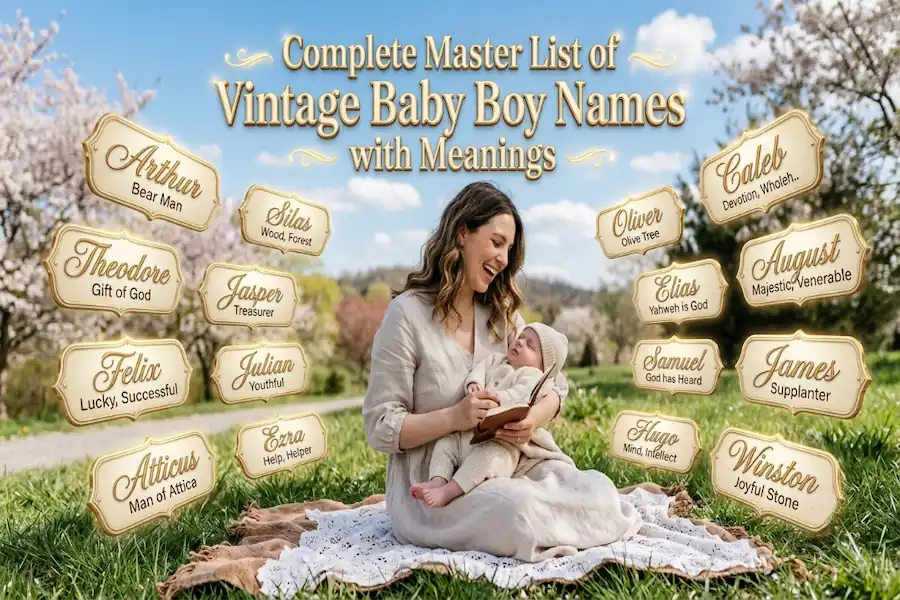
For parents who want to browse every option in one place, this comprehensive master list brings together additional vintage baby boy names that were not featured in the categorized sections above. This extended collection ensures you have access to the widest possible range of old-fashioned baby boy names, each one verified for historical authenticity and accompanied by its meaning and origin.
This list includes names from every era and tradition covered in this guide, as well as additional options that bridge multiple categories. Whether you are looking for something specific or simply want to immerse yourself in the full spectrum of vintage naming possibilities, this master list is your ultimate browsing resource. Take your time, mark your favorites, and let the names speak to you.
Remember that the best name is the one that resonates with you personally. No amount of historical significance or trendy appeal can substitute for the gut feeling you get when you say a name aloud and know it is right for your child. Trust that instinct. While some parents also research long girl names and multisyllabic girl names alongside vintage boy options when expecting a child whose gender is not yet known, every name on this list was chosen for its merit as a standalone boy’s name.
Here is your extended collection of timeless vintage baby boy names:
- Absalom – Father of peace (Hebrew)
- Adair – Oak tree ford (Scottish Gaelic)
- Adelaide – Noble nature (Germanic, historically used for boys)
- Adler – Eagle (Germanic)
- Ainsley – One’s own meadow (Old English)
- Aldric – Old ruler (Germanic)
- Alton – Old town (Old English)
- Amadeus – Lover of God (Latin)
- Archer – Bowman (Old French)
- Arden – Valley of the eagle (Celtic)
- Arlen – Pledge, oath (Irish Gaelic)
- Artemas – Gift of Artemis (Greek)
- Ashford – Ford near ash trees (Old English)
- Atwood – At the wood (Old English)
- Baldwin – Bold friend (Germanic)
- Bancroft – Bean field (Old English)
- Barlow – Bare hill (Old English)
- Baxter – Baker (Old English)
- Beckham – Homestead by the stream (Old English)
- Bellamy – Beautiful friend (Old French)
- Bertrand – Bright raven (Germanic)
- Birch – Birch tree (Old English)
- Bishop – Overseer (Old English)
- Bolton – Settlement with a hall (Old English)
- Bradford – Broad ford (Old English)
- Brighton – Bright town (Old English)
- Bronson – Son of the brown man (Old English)
- Burke – From the fortress (Old English/French)
- Burton – Fortified town (Old English)
- Carlisle – Castle of Lugus (Celtic)
- Carlton – Free man’s town (Old English)
- Carmichael – Friend of Saint Michael (Scottish Gaelic)
- Chandler – Candle maker (Old French)
- Chapin – Clergyman (Old French)
- Chapman – Merchant (Old English)
- Charlton – Free man’s town (Old English)
- Clancy – Red-haired warrior (Irish Gaelic)
- Clement – Merciful, gentle (Latin)
- Clinton – Hill town (Old English)
- Colbert – Cool and bright (Old English/Germanic)
- Coleman – Dove (Irish Gaelic)
- Connell – Strong as a wolf (Irish Gaelic)
- Cooper – Barrel maker (Old English)
- Cordell – Rope maker (Old French)
- Dalton – Town in the valley (Old English)
- Davenport – From Davenport (Old English)
- Dawson – Son of David (English)
- Deacon – Servant, messenger (Greek)
- Delmore – Of the sea (Old French)
- Dempsey – Proud (Irish Gaelic)
- Desmond – South Munster (Irish)
- Devlin – Fierce courage (Irish Gaelic)
- Dexter – Right-handed, skillful (Latin)
- Donahue – Dark warrior (Irish Gaelic)
- Donaldson – Son of Donald (Scottish)
- Driscoll – Interpreter (Irish Gaelic)
- Drummond – Ridge (Scottish Gaelic)
- Dunbar – Castle headland (Scottish Gaelic)
- Duncan – Dark warrior (Scottish Gaelic)
- Durward – Gatekeeper (Old English)
- Egan – Fire (Irish Gaelic)
- Eldridge – Old wise ruler (Old English)
- Ellsworth – Noble estate (Old English)
- Elroy – The king (Old French/Spanish)
- Elton – Ella’s town (Old English)
- Endicott – End cottage (Old English)
- Erskine – From the high cliff (Scottish Gaelic)
- Everton – Boar settlement (Old English)
- Fairfax – Fair-haired (Old English)
- Falconer – Falcon trainer (Old French)
- Farley – Fern clearing (Old English)
- Farnsworth – Fern enclosure (Old English)
- Fenwick – Farm by the marsh (Old English)
- Finley – Fair-haired hero (Scottish Gaelic)
- Fitzpatrick – Son of Patrick (Norman French)
- Fleming – From Flanders (Old English)
- Flint – Hard stone (Old English)
- Forbes – Field, district (Scottish Gaelic)
- Fordham – Homestead by the ford (Old English)
- Forester – Forest keeper (Old French)
- Fraser – Strawberry (Old French)
- Gallagher – Eager helper (Irish Gaelic)
- Gardiner – Keeper of the garden (Old French)
- Garfield – Triangular field (Old English)
- Gentry – Nobility (Old French)
- Gibson – Son of Gilbert (English)
- Gilmore – Devotee of the Virgin Mary (Irish Gaelic)
- Glendon – Settlement in the glen (Scottish Gaelic)
- Goodwin – Good friend (Old English)
- Grayson – Son of the steward (Old English)
- Grenville – Large town (Old French)
- Griswold – Grey forest (Germanic)
- Grover – Grove of trees (Old English)
- Gulliver – Glutton (Old French)
- Haddon – Heather hill (Old English)
- Halston – Hallowed stone (Old English)
- Hamilton – Treeless hill (Old English)
- Harmon – Soldier (Germanic)
- Hartwell – Stag’s spring (Old English)
- Hastings – Son of the stern one (Old English)
- Hayden – Hedged valley (Old English)
- Hendricks – Ruler of the home (Dutch/Germanic)
- Hewitt – Little Hugh (Old French)
- Holden – Deep valley (Old English)
- Hollis – Near the holly trees (Old English)
- Hudson – Son of Hugh (English)
- Humphrey – Peaceful warrior (Germanic)
- Huntley – Hunter’s meadow (Old English)
- Irwin – Boar friend (Old English)
- Jarvis – Spear servant (Germanic/French)
- Jennings – Little John (Old English)
- Jepson – Son of Jeffrey (English)
- Kendall – Valley of the River Kent (Old English)
- Kenmore – Great head (Scottish Gaelic)
- Kensington – Town of Cynesige’s people (Old English)
- Kershaw – Church copse (Old English)
- Kimball – Warrior chief (Old English)
- Lambert – Land bright (Germanic)
- Lancaster – Roman fort on the Lune (Old English)
- Landon – Long hill (Old English)
- Latimer – Interpreter (Old French)
- Lawton – Settlement on a hill (Old English)
- Leighton – Herb garden (Old English)
- Lennox – Elm grove (Scottish Gaelic)
- Linton – Flax town (Old English)
- Livingston – Leving’s town (Old English)
- Lockwood – Enclosed forest (Old English)
- Loring – Famous in war (Germanic)
- Lytton – Settlement on a hillside (Old English)
- MacGregor – Son of Gregor (Scottish Gaelic)
- Maddox – Beneficent (Welsh)
- Manning – Son of the hero (Old English)
- Marlowe – Driftwood (Old English)
- Mason – Stone worker (Old French)
- Melbourne – Mill stream (Old English)
- Meriwether – Merry weather (Old English)
- Montrose – Moor on the promontory (Scottish Gaelic)
- Mordecai – Follower of Marduk (Hebrew/Babylonian)
- Morrison – Son of Morris (English)
- Mortimer – Still water (Old French)
- Murdoch – Sea warrior (Scottish Gaelic)
- Neville – New town (Norman French)
- Newcomb – New valley (Old English)
- Newton – New town (Old English)
- Northrop – North farm (Old English)
- Norton – North town (Old English)
- Ogden – Oak valley (Old English)
- Olmstead – Elm place (Old English)
- Osborn – Divine bear (Old English)
- Osterley – Eastern meadow (Old English)
- Padgett – Page, young servant (Old French)
- Paxton – Peace town (Old English)
- Pemberton – Town on a hill (Old English)
- Pennington – Penny town (Old English)
- Perceval – Pierce the vale (Old French)
- Prentice – Apprentice (Old French)
- Radcliffe – Red cliff (Old English)
- Radley – Red meadow (Old English)
- Ramsey – Garlic island (Old English)
- Randall – Shield wolf (Old English)
- Rawlings – Son of Ralph (English)
- Redford – Red ford (Old English)
- Richmond – Rich hill (Old French/Germanic)
- Ridgeway – Path along the ridge (Old English)
- Rodney – Hroda’s island (Old English)
- Rowland – Famous land (Germanic)
- Rutherford – Cattle ford (Old English)
- Sanderson – Son of Alexander (English)
- Sanford – Sandy ford (Old English)
- Sargent – Officer (Old French)
- Schuyler – Scholar (Dutch)
- Sedgwick – Sword place (Old English)
- Sheffield – Crooked field (Old English)
- Sheldon – Steep-sided valley (Old English)
- Sherwood – Bright forest (Old English)
- Sinclair – Saint Claire (Norman French)
- Spalding – Divided field (Old English)
- Stafford – Ford by a landing place (Old English)
- Standish – Stony pasture (Old English)
- Stanford – Stony ford (Old English)
- Sterling – Highest quality (Old English)
- Stirling – Dwelling of Melyn (Scottish)
- Stratton – Settlement on a Roman road (Old English)
- Strickland – Cattle pasture (Old English)
- Sumner – Summoner (Old French)
- Talbot – Bloodhound (Old French/Germanic)
- Templeton – Town by the temple (Old English)
- Thatcher – Roof thatcher (Old English)
- Thornton – Thorn bush town (Old English)
- Thurston – Thor’s stone (Old Norse)
- Tilden – Fertile valley (Old English)
- Townsend – End of the town (Old English)
- Trevelyan – Elian’s homestead (Cornish)
- Tristan – Sad, sorrowful (Celtic)
- Tucker – Cloth softener (Old English)
- Turnbull – Strong (Scottish)
- Upton – Upper town (Old English)
- Vance – Marshland (Old English)
- Wakefield – Wet field (Old English)
- Wainwright – Wagon maker (Old English)
- Walden – Wooded valley (Old English)
- Waldo – Ruler (Germanic)
- Wallace – Foreigner (Old French)
- Waring – Guard (Germanic)
- Watson – Son of Walter (English)
- Webster – Weaver (Old English)
- Weldon – Spring hill (Old English)
- Wentworth – Winter enclosure (Old English)
- Whittaker – White field (Old English)
- Willard – Resolute brave (Old English)
- Winslow – Friend’s hill (Old English)
- Winthrop – Wine village (Old English)
- Woodward – Forest guardian (Old English)
- Worthington – Enclosure of Worth’s people (Old English)
- Wyatt – Brave in war (Old English)
- Yardley – Enclosed meadow (Old English)
Frequently Asked Questions About Vintage Baby Boy Names
Choosing a vintage baby boy name often raises questions about style, practicality, and cultural context. Below are the most common questions parents ask when exploring old-fashioned baby boy names, along with detailed answers that will help you make your decision with confidence. These answers are based on naming research, popularity data, and the collective wisdom of naming experts.
If you have been going back and forth between vintage and modern options, these answers should help clarify why classic boy names continue to be such an excellent choice for families who value both tradition and individuality.
Remember that naming is ultimately a deeply personal decision, and there are no wrong answers. The best name is the one that makes you smile every time you say it and that you believe will serve your son well throughout every stage of his life.
Here are the questions parents ask most frequently about vintage naming:
What Makes a Baby Boy Name Vintage or Old-Fashioned?
A name is generally considered vintage or old-fashioned if it was most popular during a previous era, typically before 1960, and has since declined significantly in mainstream use. The key distinction between “vintage” and simply “old” is desirability: vintage names have an enduring quality and aesthetic appeal that makes them candidates for revival, much like vintage clothing or furniture. Not every old name is vintage, but every vintage name has stood the test of time in terms of sound, meaning, and cultural resonance.
The threshold for what counts as vintage shifts over time. Names from the 1970s and 1980s are not yet considered vintage because they have not been out of circulation long enough to acquire nostalgic charm. However, names from the 1920s through 1950s are now firmly in vintage territory, and Victorian-era names are considered deeply vintage. The approximately 50-to-100-year cycle means that names from the early twentieth century are currently at peak vintage appeal.
Some names transcend the vintage label entirely because they have never fully gone out of style. Names like James, William, and Thomas have been consistently popular for centuries and are better described as “timeless” or “classic” rather than vintage. True vintage names are those that experienced a period of dormancy before being rediscovered, like Theodore, Felix, and Jasper.
Ultimately, the vintage designation is more about feeling than strict criteria. If a name evokes a sense of nostalgia, historical character, and refined elegance, it qualifies as vintage in the hearts of the parents who choose it.
What Are the Most Popular Vintage Boy Names Right Now?
According to recent Social Security Administration data, the most popular vintage baby boy names currently experiencing a major resurgence include Theodore, Arthur, Henry, Oscar, Felix, Jasper, Silas, Ezra, and Atticus. These names have climbed dramatically in the rankings over the past decade, driven by a combination of celebrity usage, cultural trends, and genuine parental enthusiasm for old-fashioned charm.
Theodore in particular has become the poster child for the vintage revival, rising from relative obscurity to become one of the top names in multiple English-speaking countries. Its meaning (“gift of God”), its distinguished history, and its adorable nickname options (Teddy, Theo, Ted) make it an almost universally appealing choice. Henry and Arthur have followed similar trajectories, benefiting from their royal associations and their appearance in popular media.
Among slightly less mainstream options, names like August, Hugo, Milo, Otis, and Arlo are climbing rapidly and may soon join the top tier. These names offer the perfect balance of vintage character and modern accessibility, making them increasingly popular among younger parents who want something distinctive but not too unusual.
If your primary concern is avoiding an overly popular name, look beyond the top 100 to options that are still in the early stages of revival. Names like Ambrose, Percival, Cornelius, and Alaric offer genuine vintage charm without the risk of becoming the next Henry or Theodore.
Are Old-Fashioned Names Coming Back in Style?
Yes, emphatically. Old-fashioned baby boy names are not just coming back; they are dominating current naming trends in a way that has not been seen in decades. This revival is part of a broader cultural movement that values authenticity, heritage, and timeless quality over novelty and trendiness. Parents across all demographics are increasingly turning to vintage options as a way to give their children names with substance and staying power.
The vintage naming trend is also being fueled by generational patterns. Today’s new parents are the grandchildren and great-grandchildren of the people who originally bore these names. There is enough temporal distance to make the names feel fresh rather than dated, and many parents report feeling a genuine emotional connection to names that remind them of beloved grandparents or great-grandparents.
Cultural influencers have also played a role. Period television shows, historical podcasts, and a general cultural fascination with earlier eras have made vintage names more visible and appealing. Social media platforms are filled with baby name discussions where vintage options consistently receive the most enthusiasm and engagement.
Naming experts predict that this trend will continue for at least the next decade, with increasingly obscure vintage names being pulled from historical records as the most well-known options become more common. The vintage revival is not a fleeting fad but a fundamental shift in how parents think about naming.
What Vintage Boy Names Are Still Unique and Uncommon?
Despite the growing popularity of vintage names, there remain hundreds of genuinely uncommon options that are virtually unheard on modern playgrounds. Names like Alistair, Ambrose, Barnaby, Cosmo, Dashiell, Florian, Ignatius, Lysander, Peregrine, and Thaddeus carry immense vintage charm while remaining statistically rare. These names sit in the sweet spot between unusual and unusable, being perfectly legitimate choices that simply have not been rediscovered by the mainstream yet.
Other deeply uncommon vintage options include Balthazar, Cedric, Ebenezer, Montague, Oberon, and Willoughby. While these names may feel bold, they have genuine historical precedent and carry meanings that are universally positive. The initial surprise that some people may feel upon hearing these names quickly transforms into admiration for their distinctive character.
The key to finding a unique vintage name is to look beyond the first wave of the revival (Theodore, Henry, Arthur) and even beyond the second wave (Jasper, Felix, Silas) to the vast unexplored territory of names that have been dormant for a century or more. These deep-cut vintage names offer maximum distinctiveness with minimum risk of feeling made up or trendy.
For parents who want the absolute rarest options, explore names from specific cultural traditions that are less commonly mined for baby names, such as Cornish, Breton, or Old Norse names. These traditions offer stunning options that most English-speaking parents will never have encountered.
How Do I Pair a Vintage First Name with a Last Name?
Pairing a vintage first name with your surname requires attention to rhythm, syllable count, and phonetic compatibility. The golden rule is contrast: if your surname is short and punchy (Smith, Jones, Clark), a longer vintage first name like Sebastian, Maximilian, or Archibald creates a pleasing balance. If your surname is long and multi-syllabic, a shorter vintage first name like Hugh, Rex, or Dean prevents the full name from becoming unwieldy.
Pay attention to the sounds at the end of the first name and the beginning of the surname. Avoid combinations where these sounds blend together awkwardly or create unintended words. For example, “Lester Stevens” runs together in a way that “Lester Morgan” does not. Similarly, matching ending and beginning consonants (like “Grant Turner”) can create a smooth, pleasing flow.
Consider the overall “weight” of the name. A very grand, formal vintage name paired with a casual, simple surname can create an appealing contrast, but it can also feel mismatched if the disparity is too extreme. Trust your ear and test each combination in real-world contexts: introducing yourself at a meeting, being called at a doctor’s office, and being announced at a graduation ceremony.
Finally, think about initials and monograms. The Southern tradition of monogramming makes this especially important, but even outside the South, initials appear on school supplies, luggage, and official documents. Write out the full set of initials including any middle name to ensure they do not spell anything unfortunate or comical.
Choosing a Vintage Baby Boy Name Your Son Will Love Forever
The journey of choosing a vintage baby boy name is one of the most meaningful experiences of parenthood. In selecting from these hundreds of old-fashioned, classic, and timeless names, you are not merely picking a label but choosing a legacy. Every name in this guide has been carried by real people across centuries, tested by time, and proven worthy of continuation. The name you choose will become your son’s constant companion, his introduction to the world, and a fundamental part of his identity.
As you narrow your list, revisit the names that made your heart skip a beat on first reading. Those instinctive reactions are often the most reliable guide. Say each finalist aloud repeatedly, imagining it in different contexts: whispered to a newborn, shouted across a playground, printed on a diploma, and spoken with pride at a wedding. The right name will feel natural and right in every scenario, carrying both the gravitas of its history and the lightness of genuine affection.
Whether you ultimately choose a well-known vintage classic like Theodore or Henry, a distinguished rarity like Percival or Alaric, or a hidden gem that even naming enthusiasts have never encountered, you are giving your son something precious: a name with roots, meaning, and enduring beauty. In a world that moves ever faster toward the new and the novel, there is profound wisdom in looking backward for the things that truly last. Vintage baby boy names are more than a trend. They are a tradition, and the best traditions are the ones worth passing on to the next generation.
Trust your instincts, honor your heritage, and choose with love. Your son’s perfect vintage name is waiting somewhere in these pages.
More related articles
One-Syllable Boy Names: 300+ Short, Strong & Powerful Names With Meanings
Choosing the perfect name for your baby boy is one of the most exciting and...
Read more →
Royal Girl Names: 300+ Elegant Baby Names Fit for a Princess
Choosing the perfect name for your baby girl is one of the most meaningful decisions...
Read more →
Southern Baby Names: 500+ Charming Names for Boys and Girls with Meanings
There is something undeniably magical about Southern baby names. They carry the warmth of front-porch...
Read more →
Trendy Baby Names: 500+ Modern & Stylish Name Ideas with Meanings
Choosing the perfect name for your little one is one of the most exciting —...
Read more →
Classic Girl Names: Over 500 Timeless and Elegant Baby Girl Names with Meanings
Choosing a name for your daughter is one of the most meaningful decisions you will...
Read more →
Vintage Baby Girl Names: 500+ Timeless Old-Fashioned Names with Meanings
Choosing a name for your baby girl is one of the most meaningful decisions you...
Read more →
Classic Boy Names: Over 500 Timeless and Traditional Names for Your Baby Boy
Choosing a name for your son is one of the most meaningful decisions you will...
Read more →